 ES
ES  HE
HE  SFR
SFR  AR
AR  EN
EN 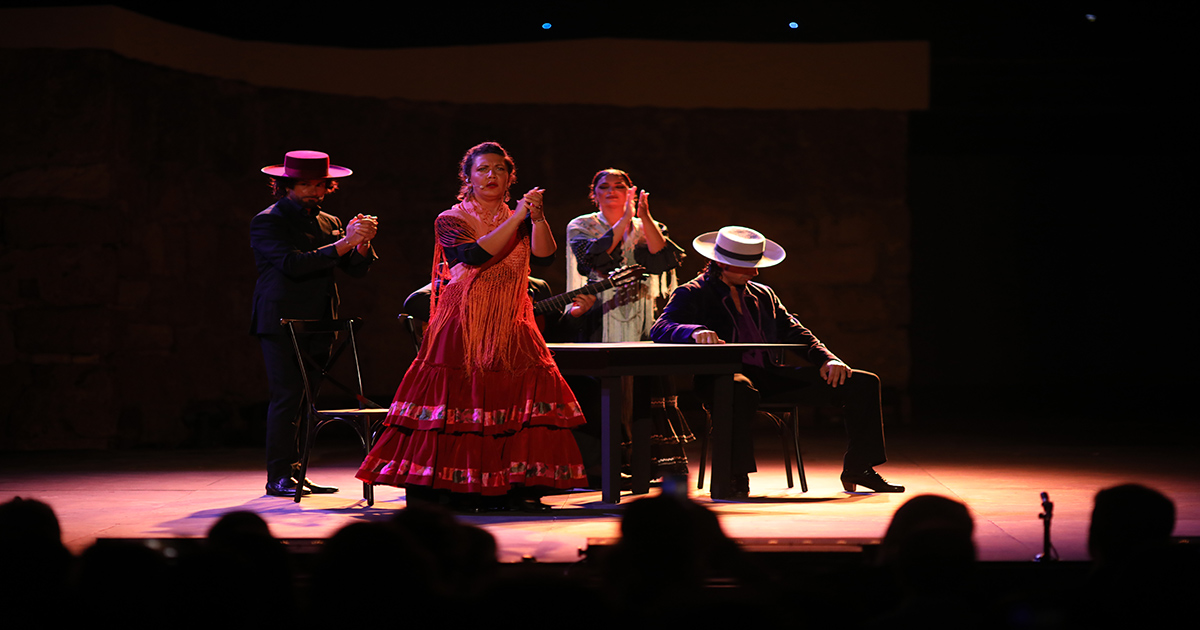
Dance, bodies, free yourselves from your chains, and write your own epic of life. Be the beginning and the end, for you are the first language and the last. Dance, and scatter beauty upon the audience, reminding them of the pain of those whose lands were seized, who fled to music and dance to forge their own revolution, and to reclaim their glory through a language that knows no end. Dance, and strike the ground with your feet, so that flamenco remains a voice for freedoms. And on the stage of Carthage, bodies made their glory on an exceptional night, Thursday, July 30, 2026, where history intertwined with the culture of life and dance, in the performance "Tierra Bendita" (Blessed Land), which celebrated the richness of Andalusian culture through a vibrant journey into the heart of traditions and emotions embodying the spirit of contemporary flamenco.
On stage, feet strike the ground with force, giving voice to history and the tales of time and place. In their dances, they employ the "Zapateado" technique—rhythmic foot stomping with powerful heel and toe strikes—as if announcing the rebirth of flamenco dance itself. Each stomp was a pulse of history, each movement a word in a long chronicle of lost Andalusia and souls that refused to surrender.
Confident movements, raised heads, clapping hands—bodies brought history and the stories of Andalusian people back to life. The delicate whisper of air with every movement transformed bodies into a symphony of rhythm, where the movement of feet and hands replaced the clamor of music. In "Tierra Bendita," everything was connected to the body and nothing else—a complete world made of a language that seems silent yet is more evocative than words, a language that tells what words cannot express.
Their dances are part of identity; indeed, they are their language, in which stories of love and separation are written through the moan of the guitar, where "Andalusia" and the "guitar" are the axis of every song. Celebration scenes were painted through group dances, for flamenco is a language born in Spain that spread to the world, becoming a voice for freedom and an echo of the struggles of peoples who refused oppression. On the Carthage stage, the dancers' bodies carried a part of Spain's heritage and painted a visual narrative of life in all its contrasts and beauty.
Among the most famous dance forms, they performed "Soleá," a meditative dance based on duets, with calm rhythms and black attire, expressing deep loneliness and sorrow, as if mourning the past and evoking the souls of those who departed. And "Alegrías," in which the dancers in their yellow dresses and flower-embroidered shawls appeared like butterflies in spring, dancing and spreading joy to the audience in the most beautiful scenes of fusion between dance and spectator, delivering a pure dose of happiness that restored hope to souls.
With the small castanets, Patricia Guerrero created a scene where the body harmonized with the clicking sounds, which began slowly and then quickly accelerated, aligning movement with rhythm and forming a unity bound by an ethereal thread of feeling and beauty. The castanets were an extension of the dancers' fingers, another heartbeat of flamenco's rhythmic core.
Flamenco rhythms are influenced by tango music, as bodies merge with the gentle rhythms emanating from guitar pulses in the "Tangos Flamencos" dance, conveying to the audience the stories of the marginalized, while the body evokes the tales of ancestors to reframe them through dance tableaus. Most stories say that flamenco was born from the suffering of Moorish peasants whose lands were seized, who mingled with the Romani people and danced their pain, with powerful foot strikes uniting with the guitar in a wild expression of lost freedom.
In the final scene of the evening, the dancers donned black, and the singer's voice rose with a melancholic melody, while the sound of feet mimicked the steps of soldiers in a battlefield, advancing and retreating. The choreographic and rhythmic precision of the dance troupe lent the scene a grandeur through which we sense human tragedy. Breath was held among the terraces of Carthage's ancient theatre, and a strange energy coursed through the venue, culminating in an explosion of applause from an audience transported to other worlds.
For the Carthage audience, the Andalusian Flamenco Ballet delivered a mesmerizing performance, choreographed by Patricia Guerrero, leading us on an artistic journey to the heart of Andalusia—the land where the spirit of flamenco was forged and evolved through history to become one of Spain's most prominent cultural expressions and one of the most globally widespread. Flamenco is a dance described by UNESCO as "emotional expressions evoked by musical instruments, facial expressions, gestures, movements, pain, and the husky voices of flamenco, as a mixture of sadness and joy, grief and elation, and fear." Since 2010, UNESCO has inscribed flamenco on its Representative List of the Intangible Cultural Heritage of Humanity.
The Andalusian Flamenco Ballet, in "Tierra Bendita," revived the traditional songs and rhythms of flamenco and re-presented them in a contemporary language, embracing innovation without abandoning flamenco's essence—that universal language that requires no translation to be understood. The dancers' movements alone were enough to record the most beautiful journeys to Spanish geography, wander through its spaces and landmarks, and listen to the tales of the Moriscos and the struggles of its people. The performance was more than a dance show; it was a chronicle of the body, a celebration of life, and an acknowledgment that art, when sincere, can transcend time and geography to reach every heart, reminding us that Andalusia is not just a place but an idea that lives in the soul of all who believe in beauty and freedom.