 ES
ES  HE
HE  SFR
SFR  AR
AR  EN
EN 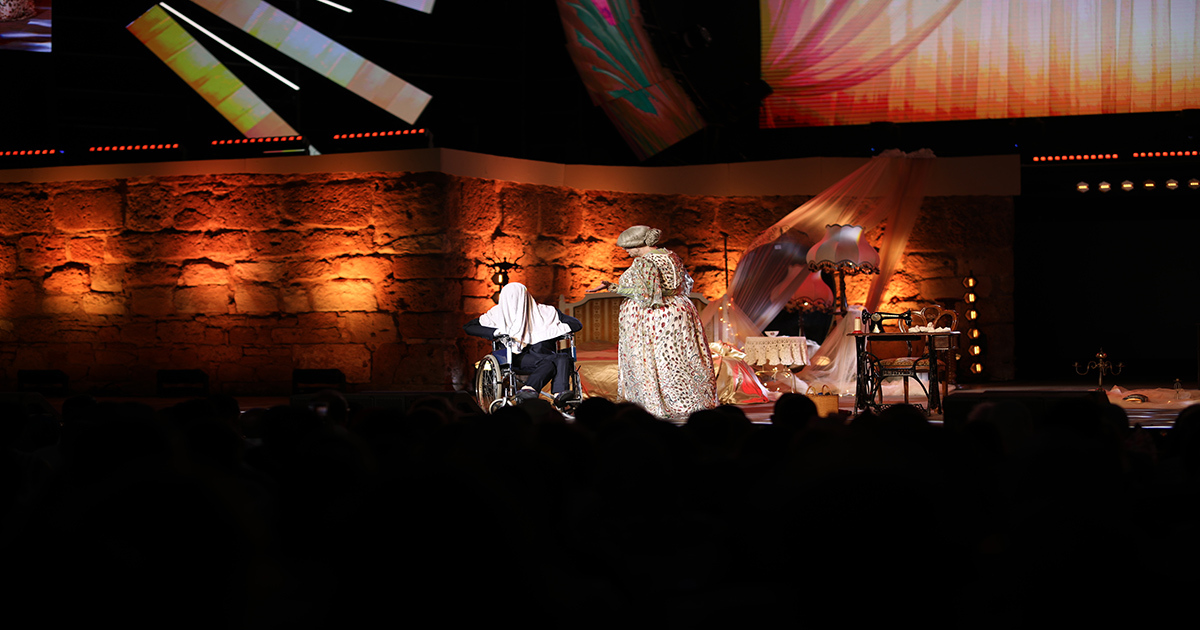
The 60th edition of the Carthage International Festival continued its diverse program, and on the evening of Sunday, July 26, 2026, the audience was treated to laughter and sharp social critique through the play "The Crazy Old Lady in the Cupboard" ("Al Garhmana Al Mokhbal Fi Keba"), written and directed by Maaz Toumi. This comedic social monodrama critiques numerous social phenomena and tackles, with satirical wit, issues that strike at the heart of Tunisian daily life.
The stage is a space for confession and dreaming, where characters are born and brought to life by the actor, reaching the audience as real and vibrant. An actor possesses the extraordinary ability to be reborn with each character, creating a dazzling world of their own. In this work, Maaz Toumi invented multiple characters, the most prominent being an elderly Tunisian woman, wise through her life experiences, carrying decades of joy, pain, and resilience.
In a moving video interaction between Maaz Toumi and his mother, as if taking revenge on Alzheimer's, Toumi wrote the play to serve as a witness and a memory. He said: "My mother suffers from Alzheimer's, and we all live with this disease, so I know its details very well." With this painful confession, the play transformed from a mere artistic work into a human document, reflecting the obsession with loss and memory, and turning the stage into a space to resist Alzheimer's through creativity and presence.
In a closed space, the "Crazy Old Lady" invents characters to escape into, each with its own complex physical and psychological composition. Toumi skillfully handled these, deconstructing their codes on stage and coloring them as he wished. In this play, a major theme emerges: the defense of imagination and the right to choose, as if the character is saying that escaping into imagination is not weakness, but a victory over a harsh, unforgiving reality.
The scenography was simple yet deeply symbolic: video mapping of the character, a sewing machine, a bed, and some furniture evoking a closed room where the story unfolds. This choice was intentional, as the director stated: "I wanted to harmonize with the Carthage stage through intelligent and simple scenography, carrying the fog that exists in the minds of Alzheimer's patients, with symbolic connections and references to the character and the contradictions she experiences." Through these symbols, the audience comes to understand the character's struggle with forgetfulness and its impact on her life and thoughts.
The "Crazy Old Lady," an elderly woman, confesses her personal pains through monologue, evoking moments of illness, tense marital relationships, loneliness, abandonment by children, social isolation, and sexual education. She raises the bigger question: the reasons behind failed marriages, silent unions, and problems that grow like a snowball, turning dreams into nightmares and love into a deadly routine.
Maaz Toumi masterfully employs theatrical writing mechanisms to critique reality without falling into didacticism. The play touched on phenomena experienced in Tunisian administration, and in a humorous format, critiqued the public system and some employees' negligence toward citizens, notably through the culture of "the network is down," which has become a symbol of bureaucratic collapse in Tunisian consciousness.
Toumi relied heavily on direct interaction with the audience throughout most of the play, making the spectator part of the event, helping to guide the character and her reactions to certain topics. The spontaneity of the "Crazy Old Lady" on stage created a space for dialogue with the audience, as seen when actress Sana Youssef was asked for help, reminding her of her failed marriage to "Nader" (a famous reference to Toumi and Youssef's iconic encounter in the series "Layali Beyda"). This spontaneous moment brought back Toumi's dream of leading roles in drama and created a profound connection with the audience.
"The Crazy Old Lady in the Cupboard" is part of a complete project that began 14 years ago, when Maaz Toumi first embodied the elderly woman character in "Farka Saboun." However, this work goes deeper, questioning the transformations Tunisian society has undergone over the decades. In this performance, Toumi concludes the character's journey on the ancient stage of Carthage. In the press conference following the show, he declared: "This character has been with me for a long time and still pulses with art, but for health reasons, it's time for her to end. Performing on stage is a physically suicidal and exhausting process... 'Against one's will, no hero is made.' Carthage is an important milestone and the best place to end the Garhmana."
The "Crazy Old Lady" has left the stage and will return to paper, but her creator still dreams of writing other characters and still believes that writing and theater have the power to color life and bring people from the darkness of oblivion into the light of encounter and permanence.
Maaz Toumi performed before a large audience, supported by the presence of fellow artists including Saber Rebai, Sana Youssef, Wajiha Jendoubi, and Aziza Boulbibar, who had previously shared his successes in "Farka Saboun." Toumi succeeded in his Carthage challenge, proving that a serious actor can win the toughest bets, and that honest, professional work reaches the audience without mediation. Thus ended the journey of the "Crazy Old Lady," awaiting new characters and texts that will be born on stage.